
Complete Guide to Business Expense Categories
Miscategorizing expenses is one of the most costly mistakes small business owners make. It can mean overpaying tax, failing an audit, or producing financial statements that give a distorted picture of your business. This guide covers the most important expense categories, what goes in each, and common traps to avoid.
Why Expense Categories Matter More Than You Think
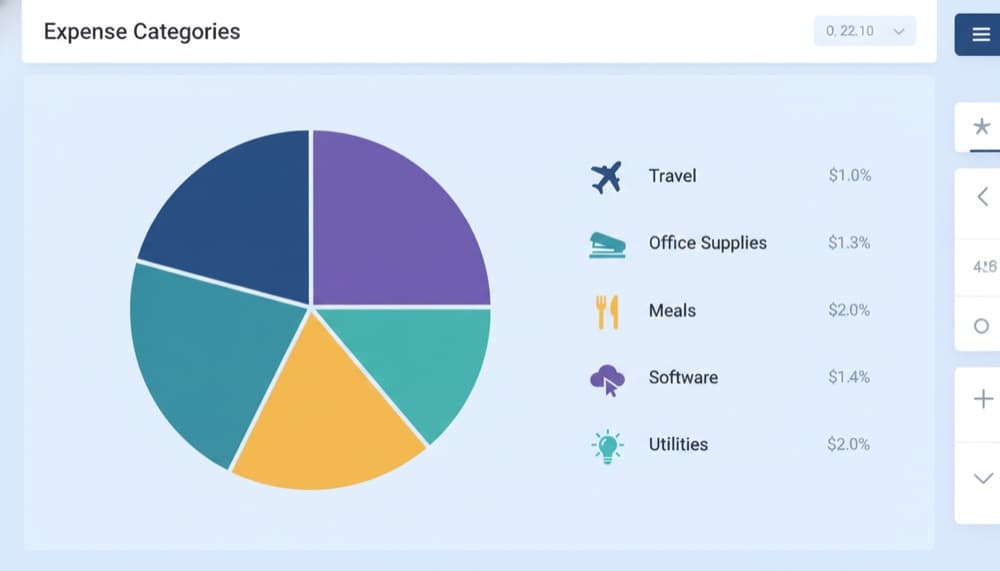
Expense categories are not just accounting labels - they drive your tax return, your financial statements, and your business decisions. When you code a meal as "Entertainment" vs "Meals & Travel," the tax treatment may differ. When you code a laptop as "Office Supplies" vs "Equipment," it affects whether the cost is expensed immediately or depreciated over time.
Key Takeaway
Consistent, correct categorization is the foundation of meaningful financial statements. If your "Miscellaneous" account is large, it is a signal that your books need attention.
Core Operating Expense Categories
Operating expenses are the costs of running your business day-to-day. They appear on your Profit & Loss statement and reduce your taxable profit.
Cost of Goods Sold (COGS)
Direct costs of producing your product or delivering your service: raw materials, direct labor, manufacturing overhead. For service businesses, COGS may include subcontractors and materials consumed on specific jobs. COGS is subtracted from revenue to calculate gross profit.
Payroll and employment costs
Wages, salaries, employer payroll taxes, health insurance contributions, pension contributions, workers compensation, and other employment-related costs. These should be tracked separately from contractor payments - misclassifying employees as contractors is a major compliance risk.
Rent and occupancy
Office rent, co-working memberships, business rates (UK), property taxes (US), utilities for your business premises, and cleaning or maintenance. If you work from home, a proportionate share of home costs may be claimable.
Software and subscriptions
SaaS subscriptions, cloud storage, accounting software, CRM, project management tools, email marketing platforms, and other recurring software costs are typically fully deductible and should be coded consistently.
Travel, Meals, and Entertainment
This category requires the most care - rules differ significantly by jurisdiction and documentation requirements are strict. Only the "ordinary and necessary" business portion is deductible.
Business travel
Flights, trains, taxis, car hire, parking, and accommodation for business trips are generally fully deductible. Mileage in your personal vehicle is deductible at the official rate (67 cents/mile US 2024, 45p/mile UK first 10,000). Keep a contemporaneous log of each trip.
Meals and entertainment
In the US, business meals are 50% deductible (post-TCJA). Entertainment - sports events, concerts - is generally not deductible at all. In the UK, staff entertainment up to £150/person per year is exempt from benefit-in-kind tax.
Correct categorization for a client visit
Flight to client meeting:         Business Travel (100% deductible)
Hotel (1 night):                  Business Travel (100% deductible)
Client dinner (2 people):         Meals & Entertainment (50% deductible)
Broadway tickets for client:      Entertainment (generally not deductible)
Taxi from airport:                Business Travel (100% deductible)

Capital Expenses vs Operating Expenses
Capital expenses are purchases that provide long-term value - equipment, vehicles, software with a multi-year license, leasehold improvements. These are not fully deductible in the year of purchase; they are depreciated over their useful life. Operating expenses are deductible immediately.
The capitalization threshold
Most businesses set a minimum value below which costs are automatically expensed. A common threshold is $500 or $1,000. A $400 office chair is expensed; a $1,200 piece of equipment is capitalized. Check with your accountant as rules vary by country.
Section 179 and bonus depreciation (US)
In the US, Section 179 and bonus depreciation rules often allow businesses to expense the full cost of qualifying assets in the year of purchase. For 2024, the Section 179 deduction limit is $1,160,000. This is a significant planning tool.
Key Takeaway
When in doubt about capital vs expense, ask your accountant. The wrong classification can materially affect your tax liability and balance sheet accuracy.
Documentation: How to Prove Every Expense
A categorized expense without documentation is a deduction at risk. Tax authorities require you to substantiate business expenses with a receipt or invoice showing vendor name, date, amount, and what was purchased. For meals and travel, add the business purpose and attendees.
How long to keep records
In the US, keep records at least 4 years (6 if you underreported income). In the UK, HMRC recommends 6 years. For capital assets, keep records for the asset's life plus 6 years.
Put this into practice with Note.now
Everything covered in this guide is built into Note.now. Try it free for 7 days.
Get started free