
What Is Double-Entry Bookkeeping?
Double-entry bookkeeping is the accounting system used by every serious business in the world. It was invented by Luca Pacioli in 15th-century Italy and has barely changed since - because it works. This guide explains the concept in plain English, why it matters, and how it operates in practice.
The Core Concept: Every Transaction Has Two Sides
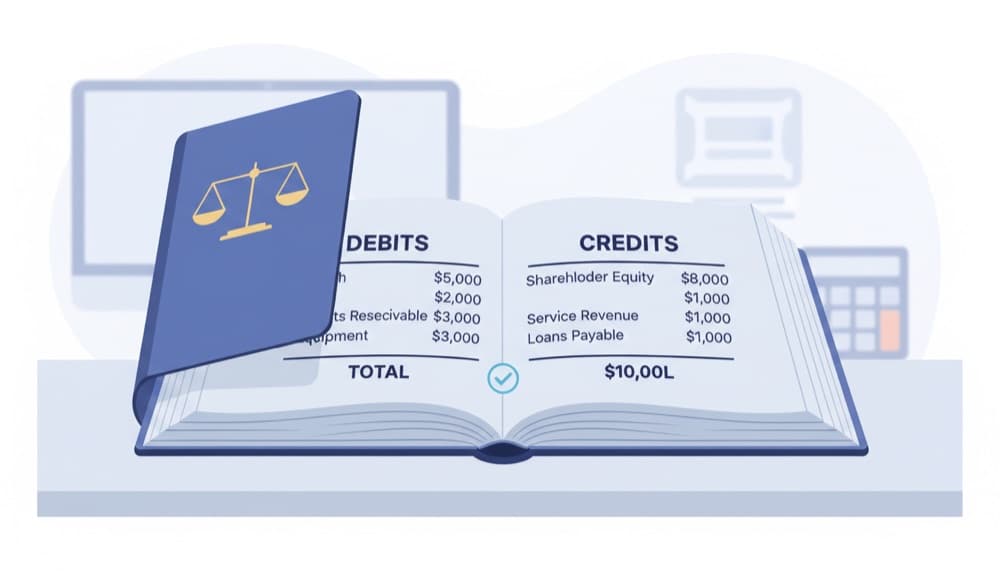
In double-entry bookkeeping, every financial transaction is recorded in at least two places. When money flows in one direction, something of equal value flows in the opposite direction. When you receive cash from a customer, you give up a receivable. When you pay a supplier, you give up cash but gain goods or reduce a liability.
Debits and credits explained simply
A debit is an entry on the left side of an account; a credit is an entry on the right. For asset accounts, debits increase the balance and credits decrease it. For liability and equity accounts, it is the reverse. The key rule: total debits must always equal total credits. If they do not, something is wrong.
Receiving payment from a client - $3,000
Debit:  Cash (Asset)    +$3,000
Credit: Revenue (Income) +$3,000

Left side equals right side. The books balance.
Key Takeaway
A debit is not bad and a credit is not good. These are just accounting terms for left and right. What matters is that they always balance.
The Accounting Equation
Double-entry bookkeeping is built on one equation: Assets = Liabilities + Equity. Every transaction must keep this equation in balance. If you borrow $10,000 from a bank (liability increases), your cash (asset) increases by $10,000. If you spend $500 on supplies (asset decreases), your equity decreases by $500 via expenses. Still balanced.
Taking out a $10,000 business loan
Before: Assets $20,000 = Liabilities $5,000 + Equity $15,000

Debit:  Cash (Asset)       +$10,000
Credit: Bank Loan (Liability) +$10,000

After:  Assets $30,000 = Liabilities $15,000 + Equity $15,000
Why Double-Entry Is Better Than Single-Entry
Single-entry bookkeeping is like tracking finances in a checkbook register - money in and money out in one column. It is simple but limited: it cannot produce a balance sheet, errors are hard to detect, and fraud is much easier to conceal. Double-entry solves all three problems.
Error detection
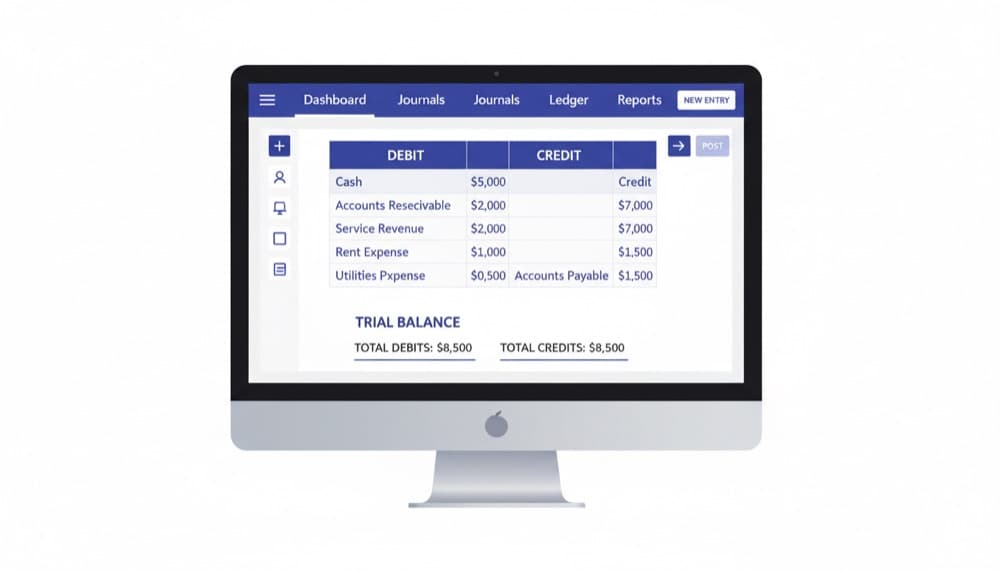
Because debits must equal credits, many errors are caught immediately. A transposition error (recording $1,800 instead of $1,080) makes the trial balance fail to balance, flagging the issue. Single-entry has no such built-in check.
Complete financial statements
Only double-entry accounting can produce all three financial statements: the Profit & Loss, the Balance Sheet, and the Cash Flow Statement. These are required for bank lending, investor relations, and tax compliance.
Key Takeaway
GAAP, IFRS, and every major accounting standard requires double-entry. Note.now operates on double-entry principles in the background - you see invoices and expenses; it handles the debits and credits.
What Double-Entry Looks Like in Everyday Business
If you use accounting software, double-entry happens behind the scenes every time you record a transaction. You do not manually write journal entries - you create an invoice, and the system records revenue and accounts receivable automatically. You pay a bill, and it records the expense and cash reduction. The double-entry mechanics are invisible; the balanced books and accurate reports are the result.
When do you see journal entries?
You only interact with journal entries directly for adjustments the system cannot handle automatically: depreciation, accruals, prepayments, and correcting errors. For everything else, accounting software handles it.
Put this into practice with Note.now
Everything covered in this guide is built into Note.now. Try it free for 7 days.
Get started free