
50 Tax Deductions Every Small Business Should Know
The tax code allows businesses to deduct the ordinary and necessary costs of running a business. Most small business owners claim far fewer deductions than they are entitled to - not from dishonesty, but from lack of knowledge. This guide covers the most commonly missed deductions.
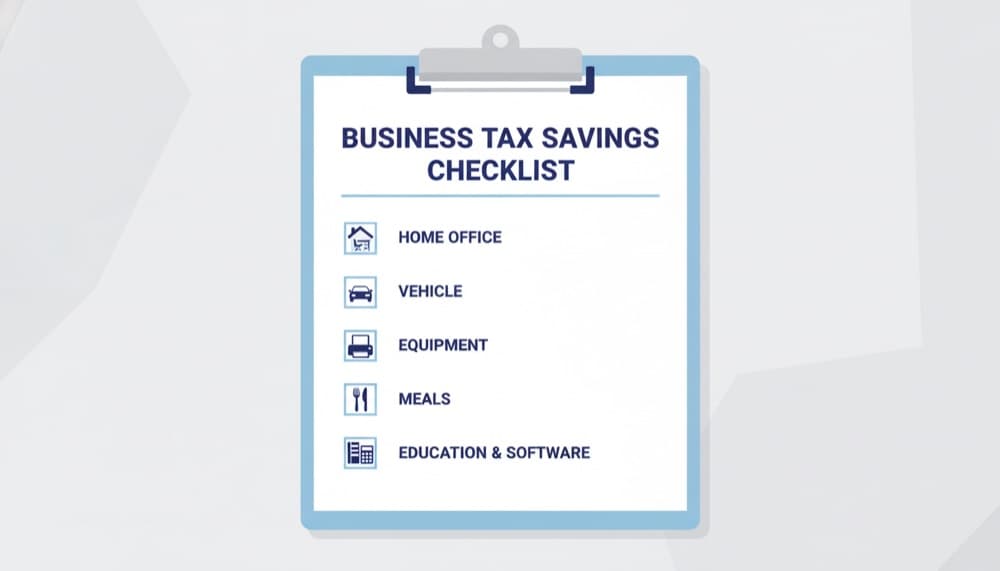
Office and Workspace Deductions
Workspace costs are among the largest deductions for most businesses. Make sure you are capturing everything you are entitled to.
Business premises
Rent or lease payments for your business premises are fully deductible. This includes office space, warehouse, storage units, and retail space. Business rates (UK) or property taxes (US, allocable to business use) are also deductible.
Home office deduction
If you use part of your home exclusively and regularly for business, you can deduct a proportionate share of home costs. In the US, use the simplified method ($5/sq ft, up to 300 sq ft) or the regular method (actual expenses × business use %). In the UK, HMRC allows a flat rate or a proportion of actual home costs.
Home office calculation (US regular method)
Home office: 200 sq ft dedicated workspace
Total home: 1,600 sq ft
Business use: 200/1,600 = 12.5%

Annual rent $24,000 × 12.5% = $3,000 deductible
Utilities $3,600 × 12.5%  = $450 deductible
Internet $1,200 × 12.5%   = $150 deductible

Total home office deduction: ~$3,600
Technology, Software, and Equipment
Technology costs are fully deductible for business use. Computers, phones, software subscriptions, and peripherals all qualify - only the business-use portion if the device is also used personally.
Software and SaaS subscriptions
Accounting software, project management tools, CRM, design software, cloud storage, video conferencing, email marketing, security software - all fully deductible in the year of payment.
Hardware and equipment
Computers, laptops, monitors, printers, phones, cameras can be deducted in the year of purchase in many jurisdictions (US: Section 179/bonus depreciation; UK: Annual Investment Allowance up to £1m). Keep receipts for all purchases.
Key Takeaway
If you use a device for both business and personal use, only the business-use percentage is deductible. Document your usage percentage - a simple log for the first few months establishes a defensible number.
Professional Services and Development
Fees paid to professionals who help you run your business are fully deductible: accountants, bookkeepers, lawyers, consultants, and financial advisors - for services related to your business, not personal financial planning.
Training and professional development
Courses, books, workshops, conferences, and professional memberships that improve your skills in your current business are deductible. Training for an entirely new career does not qualify.
Bank charges and financial fees
Business bank account fees, overdraft charges, merchant processing fees (Stripe, PayPal, Square), wire transfer fees, and foreign exchange costs for business transactions are all deductible.

Vehicles and Business Travel
Transportation is a significant deductible category that many businesses underutilize. The key is documentation: you need a mileage log or expense record for every business trip.
Mileage deduction (US)
The IRS standard mileage rate for 2024 is 67 cents per mile driven for business. Keep a contemporaneous log: date, destination, business purpose, and miles. Alternatively, deduct actual vehicle expenses in proportion to business use.
Business travel
Flights, trains, hotels, taxis, parking, and car hire for business trips are fully deductible. Keep all receipts and boarding passes. For combined business-personal trips, apportion costs between the two elements.
Marketing, Insurance, and Other Deductions
Beyond the big categories, dozens of smaller deductions add up significantly over a year.
Marketing and advertising
All costs of promoting your business are deductible: digital advertising, website design and hosting, content creation, email marketing, trade shows, business cards, and branded materials. There is no cap on the marketing deduction.
Business insurance
Professional indemnity, public liability, employers liability, product liability, cyber insurance, business interruption insurance, and key person insurance premiums are all deductible business expenses.
Key Takeaway
The biggest risk is not taking deductions you are entitled to. Keep good records, work with a qualified accountant, and review your categories at least quarterly.
Put this into practice with Note.now
Everything covered in this guide is built into Note.now. Try it free for 7 days.
Get started free