
Manage Every Part of Your Business Finances in One Place
Stop juggling spreadsheets and apps. note.now connects your invoicing, projects, expenses, and banking into one financial hub.

Most small business owners are managing their finances across five or six different tools, and that chaos is costing them time, money, and sleep.
Key Takeaways
- Centralizing your finances in one platform eliminates data gaps and reduces manual reconciliation errors.
- Real-time cash flow visibility helps you make faster, more confident spending decisions.
- Connecting invoicing, project costs, and team expenses in one place keeps every budget accurate and up to date.
- Multi-user access with defined roles means your team can act without creating compliance risks.
- A unified financial hub makes audit preparation straightforward, not stressful.

The Real Cost of Using Too Many Tools
When your invoices live in one app, your bills in another, and your bank transactions in a third, nothing ever fully matches up. You spend hours each week chasing figures that should already be connected. That friction is not just annoying, it is a genuine financial risk.
Errors creep in during manual transfers. Cash flow looks healthy until you check the actual bank balance and realize an unpaid invoice skewed everything. A unified platform fixes this at the source.
Getting Paid Faster Starts with Smarter Invoicing
Late payments are one of the top cash flow killers for small businesses. The fix is not chasing clients harder. It is making the entire payment process frictionless from the moment you send an invoice.
Send, Track, and Reconcile in One Flow
With invoicing and payments built directly into your accounting platform, every invoice you send is automatically tracked against your ledger. When a payment comes in, it reconciles instantly. No copy-pasting, no double entry.
Automated Payment Reminders
Set up automatic reminders for overdue invoices and let the system do the follow-up. This alone saves most small business owners several hours a month. It also removes the awkwardness of chasing a client you actually like.
Example — Service Business Invoice Cycle
Invoice sent:         $4,200 (project completion, Day 1)
Payment terms:        Net 14
Auto-reminder sent:   Day 15 (overdue by 1 day)
Payment received:     Day 17
Reconciled to ledger: Automatic, same day
Time spent manually:  0 minutes
Control What Goes Out, Not Just What Comes In
Revenue gets the attention, but expenses quietly determine whether a business is actually profitable. Managing your outgoings with the same precision you apply to income is what separates businesses that scale from those that stall.
Vendor Bills and Payment Scheduling
When you manage bills and vendors inside your accounting platform, every supplier payment is tied to a real transaction. You can schedule payments, track what is due, and avoid late fees without spreadsheet gymnastics.
Team Expense Claims Without the Paper Trail
Staff expenses are often the messiest part of small business accounting. With integrated expenses and claims, team members submit receipts digitally and claims route through an approval workflow automatically. Approved claims post to your books in real time.
Example — Monthly Expense Claim Process
Staff claims submitted:    12 (total value $1,840)
Claims approved:           12
Time to approve:           Under 10 minutes (manager review via mobile)
Manually entered to books: 0
Reimbursement processed:   Same pay cycle
Keep Project Budgets and Business Finances Aligned
Project overruns rarely happen because of one big mistake. They happen because costs accumulate quietly while the project budget and the accounting system never talk to each other. Fixing that connection changes everything.
Track Costs at the Project Level
With project management integrated into your financial platform, you can assign costs, time, and invoices to specific projects. You see profitability per job, not just across the business as a whole. That detail is where better decisions get made.
Spot Budget Blowouts Before They Happen
Real-time cost tracking against a project budget gives you an early warning system. If a contractor invoice pushes a project over 80% of its budget while it is only 60% complete, you know immediately. Not at month-end, and not after the invoice has already been paid.
| Project | Budget | Costs to Date |
|---|---|---|
| Office Fitout — Client A | $18,000 | $11,200 (62%) |
| Web Redesign — Client B | $9,500 | $9,100 (96%) |
| Brand Campaign — Client C | $22,000 | $8,800 (40%) |
| IT Infrastructure — Internal | $6,000 | $5,400 (90%) |
| Training Program — Internal | $3,200 | $1,050 (33%) |
Real-Time Cash Flow Means Real Decisions
A bank balance is not a cash flow position. Knowing what is sitting in your account right now tells you almost nothing about what the next 30 days actually look like. That gap between perception and reality is where businesses get into trouble.
Connect Your Bank and See the Full Picture
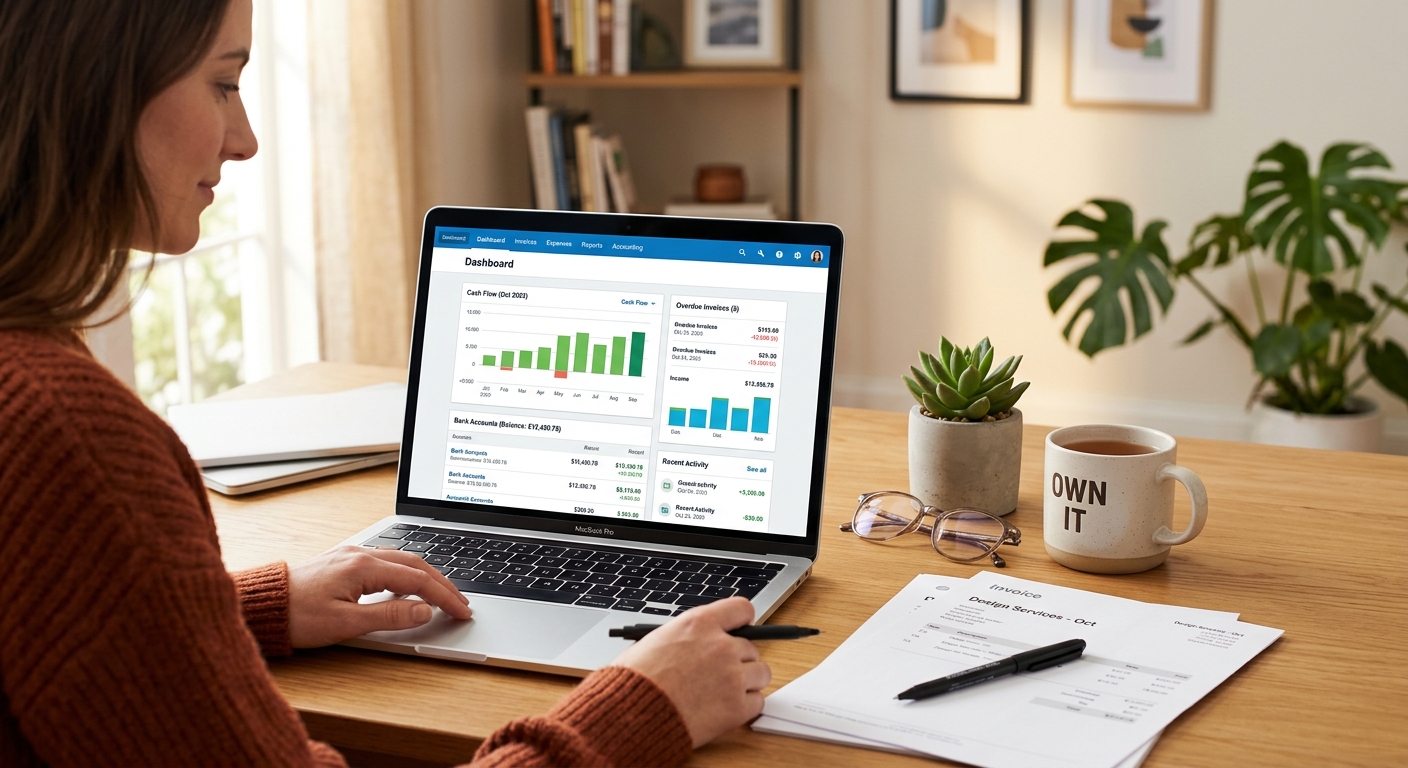
With banking and cash flow connected to your platform, your incoming invoices, scheduled bills, and bank transactions are all factored into one live view. You see what you owe, what is owed to you, and what your runway looks like, all in the same screen.
Forecasting Without the Guesswork
When your accounting data is complete and current, 30 and 60-day cash flow forecasting becomes practical rather than theoretical. You can plan a hire, time a large purchase, or spot a shortfall weeks before it arrives.
Build a Team That Can Work Without Creating Chaos
Growth creates complexity. More people touching the finances means more opportunities for errors, duplicate entries, and unauthorized actions. The answer is not locking everyone out. It is giving the right people the right access.
With proper team and organization settings, you can define exactly what each person can see and do. A project manager can log costs and review budgets. A bookkeeper can reconcile transactions. An owner can see everything. Nobody steps on each other's work.
Here is how to approach access levels for a growing team:
- Map roles to responsibilities first. List what each person actually needs to do in the system before assigning any permissions.
- Start with minimum access. Give team members access to what they need today. You can expand it as trust and responsibility grow.
- Keep financial reporting owner-only. Profit and loss, balance sheet, and cash flow reports should stay at the top level unless there is a specific reason to share them.
- Review access quarterly. As roles change, permissions need to change with them. A quarterly check takes ten minutes and prevents a lot of problems.
- Log everything. A good platform keeps an audit trail of who did what and when. Make sure yours does, and check it periodically.
Stay Audit-Ready Without Extra Work
Most small businesses dread an audit because their records are scattered. Some things are in email attachments, some are in spreadsheets, and some only exist in the memory of whoever did the bookkeeping two years ago. A centralized platform fixes this permanently.
When everything runs through core accounting from the start, your records are complete by default. Every transaction has a source. Every entry has a timestamp. Every claim has an attached receipt. There is nothing to reconstruct at the end of the year because it was always there.
Keeping audit-ready records throughout the year means:
- Year-end close takes days, not weeks.
- Your accountant spends less time asking questions and more time advising you.
- Tax filing is based on accurate, verified data, not best estimates.
- If a question ever arises, you can answer it in minutes with a filtered report.
- Lenders and investors get clean financials fast, which matters when timing is critical.
One Platform, Every Part of Your Business
The goal was never to use more software. It was to run a business confidently, make good financial decisions quickly, and have records you actually trust. That is what a connected financial platform gives you.
When your invoicing, project costs, vendor bills, team claims, banking, and core accounting all feed into the same system, the noise disappears. You stop reconciling and start running your business. The financial picture is always current, always complete, and always yours to act on.
note.now is built so every one of these pieces works together from day one. You do not need to integrate five tools or hire someone just to keep them aligned. Everything is already in the same place, waiting for you to use it.
Put this into practice with Note.now
Everything covered in this article is built into Note.now. Try it free for 7 days.
Get started free